Technical debt is visible. You can see it in the codebase — the workarounds, the deprecated patterns, the test coverage gaps that accumulated over time. When you carry technical debt into a new feature, something usually breaks in a traceable way.
Context rot is invisible. It looks exactly like current, accurate information right up until an AI tool acts on it.
In AI-assisted product development, stale context doesn't announce itself. A specification document written in January that references a design decision from November — a decision that was superseded in March — looks identical to a current document. The AI tool loading it has no mechanism to perceive the difference. It reads the January document, finds the November reference, and builds on an assumption that everyone involved in the project knows is no longer accurate.
Everyone knows. But AI doesn't know what everyone knows.
What Context Rot Looks Like in Practice
On a long-running AI-assisted healthcare engagement, the project accumulated over forty named specification documents across several months. By the later workstreams, the working context flagged nearly every stage specification as "PENDING redesign" — a domain architecture decision had been approved that required revisions across dozens of documents. The visual reference document from the beginning of the engagement still showed a navigation model that had been changed in a subsequent session. Multiple documents contained cross-reference notations pointing to other documents that had been updated, without themselves being updated to reflect the change.
Every one of those conditions looked, to the project team, like normal active work. But the dependencies between documents — the fact that Document A's accuracy depended on Document B's current state — weren't automatically enforced. When an AI tool loaded Document A in a session focused on something else, it had no reason to flag that Document B had changed.
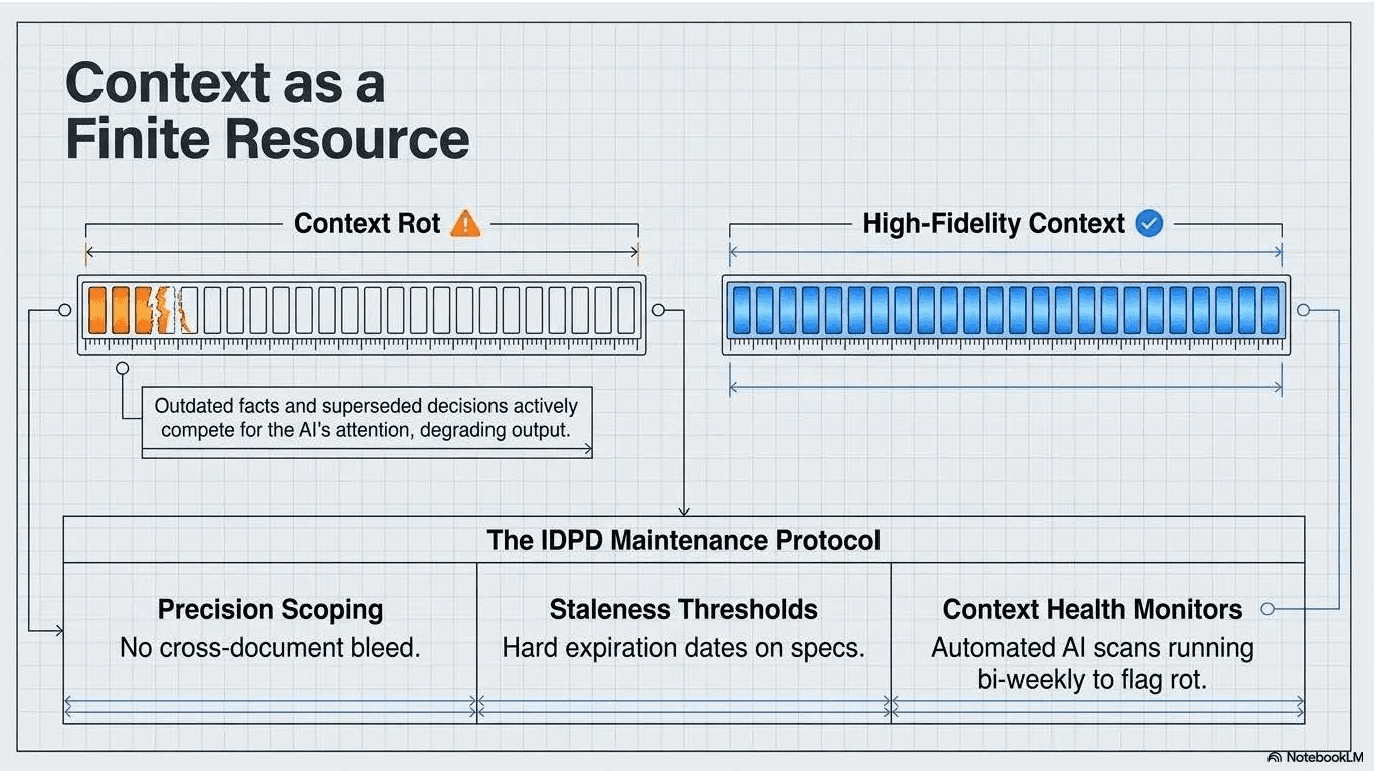
This is the mechanism of context rot: stale content competes for the AI's attention with current content, with no signal to distinguish between them. The AI doesn't suppress the stale content. It incorporates it.
Why This Is Different from Traditional Documentation Drift
In a human-only product process, documentation drift is annoying but containable. Teams develop informal corrections — people know that the spec from three months ago doesn't reflect the current navigation model, even if the spec itself hasn't been updated. That knowledge lives in people. In conversations.
AI tools don't have access to what people know. They have access to what's written. Every stale document is an authoritative source until explicitly superseded. The informal corrections that human teams rely on to navigate documentation drift don't translate to AI context.
Worse: in AI-augmented projects, documentation volume is significantly higher than in human-only projects. The same speed that makes AI valuable in specification production creates more surface area for context rot to develop.
Context Rot Is a Product Quality Issue
The instinct is to treat context rot as an administrative problem — a documentation hygiene issue someone should clean up when they get to it. That framing misses the severity.
Context rot is a product quality issue because stale context produces incorrect AI output, and incorrect AI output in a specification workflow produces specification that doesn't reflect current product intent. The product leader approves the output — which looks correct — without realizing it's been shaped by an assumption that has since been superseded. The specification proceeds to engineering. Engineering builds to the specification. The discrepancy surfaces during testing or, worse, after launch.
No one made a bad decision. The AI followed the instructions it was given — instructions that included, without any distinguishing marker, a piece of context that everyone except the AI knew was no longer accurate.
The Context Health Monitor
IDPD treats context rot prevention as a scheduled operational discipline, not a cleanup task. The Context Health Monitor is a bi-weekly check — run on a fixed cadence, not triggered by a detected problem — that flags three specific conditions.
Documents past their staleness threshold: any document not reviewed within a defined window gets flagged regardless of whether anyone suspects it's outdated.
Documents with stale dependencies: if Document B was updated after Document A was last reviewed, Document A may be stale even if it's within its review window. The dependency chain matters, not just the document date.
Open source conflicts: when two documents contain different versions of the same decision, the conflict needs to be flagged and resolved before the next specification session, not deferred to handoff.
The discipline is preemptive, not reactive. Context rot is significantly cheaper to prevent than to correct — but only if the prevention mechanism runs before the AI builds on the stale context, not after.
The Practical Implication
At the start of every AI-assisted specification session, the first question should be: which documents in this session's working context have dependencies that may have changed since they were last reviewed?
That question isn't instinctive in a project culture shaped by human-only processes, where informal knowledge handles the dependencies. It has to be deliberately built into the session protocol.
When it is, context rot is manageable. When it isn't, the specifications are only as accurate as the stalest document in the context window — and no one can tell which one that is.
The principle: In AI-assisted projects, stale context actively misdirects AI output without any visible signal. Context hygiene is a product quality problem, not an administrative one.
Frequently Asked Questions
What is context rot in AI product development?
Context rot is the condition where AI tools are loading stale, outdated, or superseded documents alongside current ones — with no mechanism to distinguish between them. Because AI has no access to the informal knowledge that allows human teams to work around documentation drift, stale context produces incorrect output that looks identical to correct output.
How is context rot different from technical debt?
Technical debt is visible and traceable — its effects show up in the codebase in ways that can be diagnosed. Context rot is invisible: it looks like current, accurate information and produces plausible-seeming AI output. The error only becomes detectable when the discrepancy surfaces downstream, often during engineering or testing.
What is the Context Health Monitor in IDPD?
The Context Health Monitor is a scheduled bi-weekly check in IDPD that proactively flags three conditions: documents past their staleness threshold, documents with stale dependency chains, and open source conflicts between documents describing the same decision differently. It runs on a fixed cadence, not triggered by a detected problem.
Why is context rot worse in AI-augmented projects than in human-only projects?
Two reasons. First, AI tools have no access to the informal knowledge that human teams use to work around documentation drift. Second, AI-augmented projects produce significantly more documentation — creating more surface area for context rot to develop. The same production velocity that makes AI useful amplifies the consequences of context rot if prevention mechanisms aren't in place.