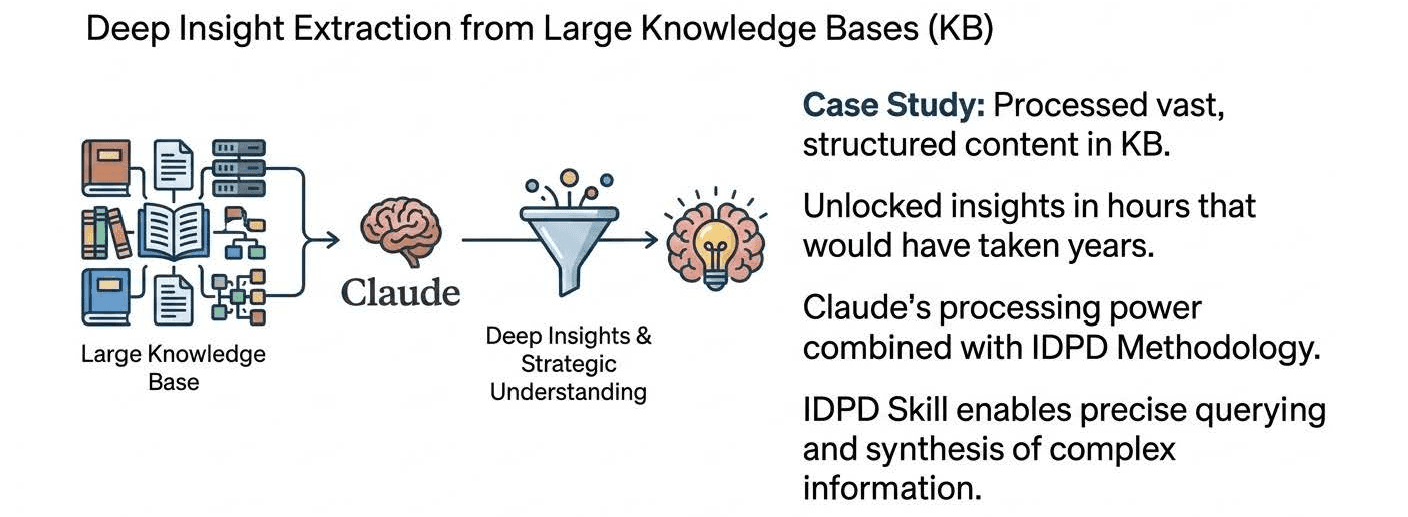
Human researchers sample. Review a corpus of 500 items and a skilled researcher will look at 50, maybe 75, form a well-informed impression, and build from it. That's not a failure of rigor — that's the practical limit of what a person can process in a reasonable timeframe. The sampling is strategic. The impression is informed. The conclusions are reasonable.
But sampling produces hypotheses. The full corpus produces structural findings.
The difference matters when what you're building depends on the finding being right.
What the Full Corpus Found
On a healthcare AI engagement, a knowledge base of 516 items across five specialized databases was processed in its entirety — not sampled. Every item was evaluated, tagged, and cross-referenced against a controlled vocabulary and a multi-condition taxonomy.
The finding: 74% of the impairment care content addressed multiple conditions simultaneously.
That's not a finding a sampling approach would have produced reliably. Sample 50 items from a corpus of 516 and the probability of accurately capturing a 74% distribution is low. A reasonable estimate from sampling might have suggested "a significant portion" of content addresses multiple conditions. That's a hypothesis. 74% is a structural finding. The difference in what those two things authorize is significant.
Hypothesis vs. Structural Constraint
A hypothesis is something you design around tentatively and validate later. You make architectural choices that assume the hypothesis is roughly correct, and you build in validation checkpoints where the assumption will be tested. If the validation confirms the hypothesis, you proceed. If it doesn't, you revise.
A structural finding is something you design from. It becomes a constraint on the architecture, not an assumption to be tested. When 74% of your knowledge base content is cross-condition by nature, that's not a design assumption about user behavior — it's a fact about the content that any architecture has to account for. The architecture that doesn't account for it is the wrong architecture, regardless of how well it's built.
On the engagement above, the 74% finding didn't prompt a design assumption. It produced a cross-condition architecture — a design that treated multiple simultaneous conditions as the norm, not the exception, because the evidence said the norm was 74%. Users presenting with a single isolated condition were the exception. The architecture reflected that reality.
Had the finding been a hypothesis — "a significant portion of users present with multiple conditions, let's design accordingly and validate" — the architecture might have been built with single-condition handling as the default and multi-condition as an extensible add-on. That architecture would have required significant rework when the 74% figure was eventually confirmed. Full corpus processing moved that discovery to the moment when it could still shape the architecture, before any architectural decisions were final.
What AI Makes Possible That Wasn't Possible Before
This is the category of AI contribution that practitioners most often underestimate: not speed, but scale of synthesis.
A human research team processing 516 items — even with dedicated resources — would require weeks and would rely on sampling to complete the work in a reasonable timeframe. The synthesis that follows sampling is informed, but it's working from a subset. The conclusions are as good as the sample.
AI processes the full corpus. Every item gets the same evaluation. The taxonomy is applied consistently without the fatigue, implicit pattern-matching, and cognitive loading that affects human reviewers after the thirtieth item. The cross-referencing — which items relate to which other items, which conditions appear together, which content types span multiple conditions — can be executed at a scale that sampling can't replicate.
The output isn't just faster. It's categorically different. Sampling produces estimates. Full corpus processing produces distributions. Estimates authorize hypotheses. Distributions authorize architecture.
The Knowledge Base as a Design Input
The standard treatment of a knowledge base in product development is as a reference resource — a body of content the product will surface to users. The question teams ask about it is: "what's in here, and how do we organize it?"
The more useful question is: "what does this corpus, taken as a whole, tell us about the product architecture we need to build?"
That question requires processing the full corpus. You can't answer a structural question about the distribution of a knowledge base from a sample of it. The sample can tell you what kind of content is in there. The full corpus tells you what the content actually is — its actual distribution, its actual cross-condition relationships, its actual concentration in specific topic areas.
On the healthcare engagement, the 516-item analysis didn't just inform content organization. It changed the core product architecture. The multi-condition finding wasn't incorporated as a feature (a "multi-condition mode" the product could activate). It was incorporated as a structural assumption — the product was built from the ground up to handle cross-condition complexity as the default state, not as an extension of a single-condition baseline. Retrofitting a single-condition architecture to handle a 74% multi-condition reality is significantly more expensive than building the right architecture from the start.
The Multiplier Is in the Synthesis
The conversation about AI in product development tends to focus on production speed: how fast can we generate specifications, how many output hours can AI compress into AI-assisted hours?
The multiplier that matters more, in practice, is synthesis scale. How many inputs can be processed simultaneously and coherently? How many cross-references can be maintained across a large corpus? How many simultaneous dimensions — clinical, regulatory, user experience, technical — can be held in active context while producing a finding?
Human researchers process sequentially. They hold significant context in memory, but the number of active cross-references they can maintain simultaneously has limits. AI holds the full corpus in context simultaneously. The cross-condition relationships that a human researcher would note for one or two items per session emerge as a distribution across all 516 items.
The finding that came out of processing those 516 items was a 74% figure that shaped a product architecture. A sampled estimate would have produced an informed guess. The full corpus produced a structural constraint. Those two things authorize different architectures. Building on the right one doesn't require a rebuild.
The principle: Sampling produces hypotheses. Full corpus synthesis produces structural findings. The architecture you build is only as good as the quality of finding it's built on.
Frequently Asked Questions
What is the difference between AI sampling and AI synthesis in knowledge base analysis?
Sampling selects a subset of a knowledge base for review and extrapolates conclusions from that subset. Synthesis processes the full corpus consistently and produces findings based on the actual distribution of the full dataset. Sampling produces informed estimates; full corpus synthesis produces structural findings that can directly constrain product architecture.
Why does it matter whether a finding is a hypothesis or a structural constraint?
Hypotheses authorize tentative design decisions that require validation checkpoints. Structural findings authorize architectural decisions made before any validation, because they're based on the actual state of the corpus rather than an estimate of it. Products designed on structural findings require less rework when those findings are confirmed; products designed on hypotheses sometimes require architectural rework when validation reveals the hypothesis was wrong or imprecisely stated.
What types of findings emerge from full corpus knowledge base analysis that sampling would miss?
Distribution findings (what percentage of content falls into a specific category), cross-reference patterns (which condition types appear together, which content types span multiple domains), concentration findings (which topic areas are underrepresented or overrepresented relative to design assumptions), and structural features of the corpus that only become visible when the full dataset is analyzed rather than a subset.
How does knowledge base synthesis change product architecture decisions?
When synthesis reveals that a significant percentage of content is inherently cross-condition or cross-category, the product architecture can be designed with that reality as a baseline assumption rather than an extensible feature. This changes the core data model, the content surfacing logic, and the AI calibration approach — not as add-ons to a single-condition architecture, but as the structural foundation that a single-condition architecture would have to be retrofitted to support.